

How Gentle Art Therapy Heals Your Mind
The Essence of Gentle Art Therapy for Emotional Recovery
A woman I know spent three years in traditional talk therapy after losing her mother. She made progress, sure, but something remained lodged in her chest that words couldn’t reach. Then her therapist handed her a box of pastels and said, “Just make marks on the paper. Don’t think about it.” Within twenty minutes, she was sobbing in a way she hadn’t allowed herself to in years. The colors she chose, the pressure of her hand, the chaotic circles she drew expressed something her vocabulary had failed to capture.
This is how gentle art therapy works on the human psyche. It bypasses the logical, verbal brain and speaks directly to the emotional centres that hold our pain, joy, and everything in between. Unlike traditional art classes focused on technique or outcome, this therapeutic approach prioritizes process over product. There’s no grade, no critique, no “right way” to create.
The mental health field has increasingly recognized what ancient cultures always knew: creative expression heals. Research from institutions like Drexel University and the American Art Therapy Association demonstrates measurable reductions in anxiety, depression, and trauma symptoms among participants. But you don’t need a clinical study to understand why putting color on paper when you’re struggling feels like releasing a valve on internal pressure.
Defining the Low-Pressure Creative Approach
Gentle art therapy differs from conventional art-making in one crucial way: the emphasis shifts entirely from the finished piece to the experience of creating it. A trained art therapist won’t evaluate your drawing skills or suggest you add more shading. Instead, they might ask what you noticed in your body while you worked, or what memories surfaced as you selected certain colors.
This approach removes performance anxiety from the equation. Many adults carry wounds from childhood art classes where their work was criticized or compared unfavorably to peers. Gentle art therapy actively works against these old injuries by establishing safety as the foundation of every session.
The materials themselves are chosen for accessibility. Soft pastels, crayons, watercolors, and clay require no special training. They respond to touch in intuitive ways that even young children understand instinctively.
Moving Beyond Artistic Skill and Perfectionism
Here’s something therapists observe constantly: the clients who struggle most with gentle art therapy are often high achievers. Lawyers, executives, and academics frequently freeze when handed art supplies because they’ve spent decades being evaluated on outcomes. The idea of creating something “bad” triggers genuine distress.
This resistance actually becomes part of the healing work. Learning to make ugly, messy, imperfect art teaches the nervous system that failure isn’t dangerous. Each “failed” piece of art that doesn’t result in rejection or punishment rewires old beliefs about worthiness being tied to performance.
The goal isn’t creating something beautiful. The goal is creating something true. Sometimes truth looks like angry red scribbles. Sometimes it looks like a careful arrangement of blue dots. Both are equally valid expressions of internal experience.
Neurological Benefits of Creative Expression
The brain doesn’t distinguish between “real” art and therapeutic art. When your hands engage with creative materials, specific neural pathways activate regardless of whether you’re Picasso or a complete beginner. Understanding this neuroscience helps explain why art therapy produces such consistent results across diverse populations.
Activating the Parasympathetic Nervous System
Your autonomic nervous system operates like a seesaw. On one side sits the sympathetic branch, responsible for fight-or-flight responses. On the other sits the parasympathetic branch, sometimes called “rest and digest.” Most people with anxiety, trauma, or chronic stress have seesaws stuck on the sympathetic side.
Gentle, repetitive creative motions activate the parasympathetic system. The rhythmic movement of a brush across paper, the rolling of clay between palms, the meditative focus of adding small details to a drawing: these actions signal safety to the brain. Heart rate slows. Breathing deepens. Muscle tension releases.
Brain imaging studies show decreased activity in the amygdala, the brain’s fear center, during creative activities. Simultaneously, prefrontal cortex activity increases, improving emotional regulation and decision-making. This neurological shift explains why many people report feeling calmer after just fifteen minutes of mindful art-making.
The Role of Flow State in Reducing Cortisol
Flow state, that absorbed condition where time seems to disappear, represents the brain’s optimal functioning mode. During flow, cortisol levels drop significantly. The stress hormone that contributes to inflammation, weight gain, and immune suppression decreases measurably when people engage in absorbing creative work.
Art activities are particularly effective at inducing flow because they offer immediate feedback and adjustable challenge levels. Unlike competitive activities where external factors determine difficulty, art allows you to make the task exactly as simple or complex as you need in the moment.
A 2016 study published in Art Therapy journal found that just 45 minutes of creative activity significantly lowered cortisol levels regardless of participants’ prior art experience. The reduction occurred whether people considered themselves “artistic” or not, confirming that the benefits come from the process itself.
Healing Trauma Through Non-Verbal Communication
Trauma often resists verbal processing because it’s stored differently than ordinary memories. The brain encodes traumatic experiences in sensory, emotional, and physical forms that don’t translate easily into language. This explains why trauma survivors frequently say things like “I know I should be over it, but my body won’t let go.”
Accessing Subconscious Emotions via Color and Shape
Color choices in art therapy sessions often reveal emotional states that clients haven’t consciously acknowledged. Someone might insist they’re “fine” while repeatedly reaching for black and gray. Another might discover unexpected anger when they find themselves pressing so hard with red that the crayon breaks.
These non-verbal communications provide valuable therapeutic information. A skilled art therapist notices patterns: the client who always draws themselves tiny in the corner of the page, the one whose figures never have hands, the one who compulsively erases and starts over.
Shape and composition carry meaning too. Jagged lines often correlate with anxiety or agitation. Enclosed shapes can represent feelings of being trapped. Open, flowing forms frequently emerge as clients begin feeling safer and more expansive. None of these interpretations are absolute rules, but they offer starting points for deeper exploration.
Processing Memories Without Forced Dialogue
Traditional talk therapy requires putting experiences into words, then speaking those words to another person. For many trauma survivors, this process feels impossible or retraumatizing. The pressure to verbalize can actually increase dissociation and shutdown.
Art therapy offers an alternative pathway. Creating a visual representation of an experience allows processing without the demand for coherent narrative. A client might paint their childhood home without ever describing what happened there, yet still release stored emotional charge through the act of externalizing the image.
This approach proves especially valuable for preverbal trauma, experiences that occurred before language development. Adults who were neglected or abused as infants have no words for those experiences, but their bodies and emotions carry the imprint. Art provides a language that predates speech.
Practical Gentle Art Techniques for Daily Wellness
You don’t need a therapist present to benefit from art therapy principles. Many techniques translate effectively into self-directed practice, offering accessible tools for managing daily stress, processing difficult emotions, and building emotional resilience over time.
Mindful Doodling and Zentangles for Anxiety
Zentangle, a structured form of meditative drawing, was specifically developed to induce relaxation through repetitive pattern-making. The practice involves filling small spaces with repeated strokes, creating intricate designs one simple shape at a time.
The method works for anxiety because it occupies the mind just enough to prevent rumination without requiring complex decision-making. You’re not choosing what to draw; you’re simply filling space with predetermined patterns. This sweet spot of engagement allows worried thoughts to quiet naturally.
Start with a small square of paper, no larger than 3.5 inches. Draw a border, then add a few curved lines to create sections. Fill each section with a different repeating pattern: dots, crosshatching, spirals, or waves. The constraint of the small space makes the task feel manageable rather than overwhelming.
The Soothing Power of Watercolor Washes
Watercolor behaves unpredictably. The pigment flows, bleeds, and blooms in ways you can’t fully control. For perfectionists, this initially feels frustrating. With practice, it becomes profoundly liberating.
Wet-on-wet technique, where you apply paint to pre-moistened paper, maximizes this unpredictability. The colors merge and move on their own, creating effects you couldn’t achieve through careful planning. Watching this happen teaches acceptance of outcomes you didn’t orchestrate.
Try this simple exercise: wet an entire sheet of watercolor paper with clean water. While it’s still glistening, drop in colors that appeal to you. Tilt the paper gently and watch them interact. There’s no wrong result. The paper dries into something unique every time, a reminder that beauty often emerges from releasing control.
Tactile Healing with Clay and Textures
Touch activates different neural pathways than visual art. Working with clay, in particular, engages proprioceptive senses that connect you to your physical body. For people who dissociate or feel disconnected from physical sensations, this grounding effect proves especially valuable.
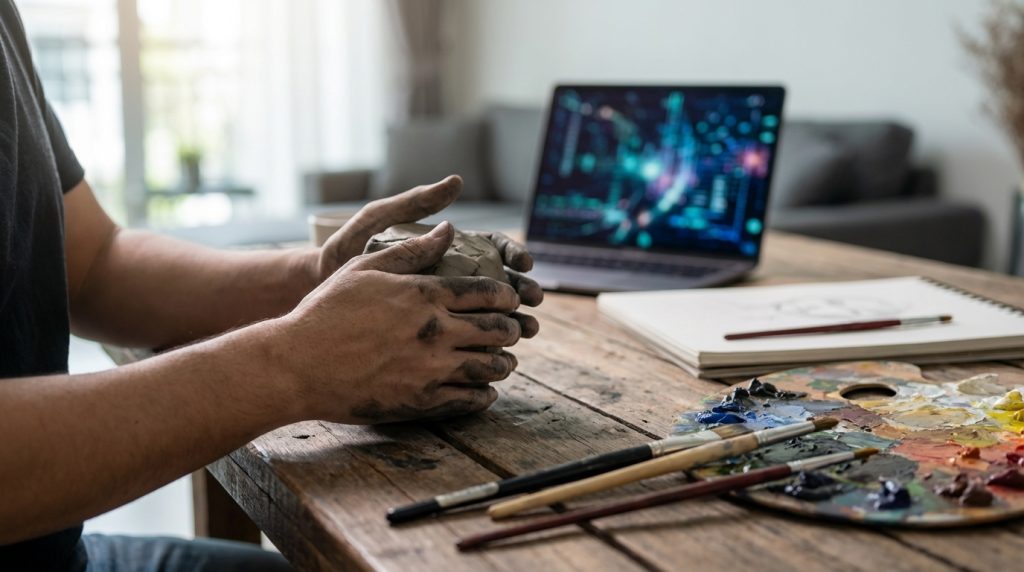
Air-dry clay requires no special equipment and can be worked at a kitchen table. The physical actions of kneading, rolling, pressing, and shaping release muscular tension while focusing attention on immediate sensory experience. You don’t need to make anything recognizable. Simply manipulating the material provides therapeutic benefit.
Texture collage offers another tactile option. Gather materials with varied surfaces: sandpaper, velvet, bubble wrap, dried leaves, corrugated cardboard. Arrange and glue them based purely on how they feel under your fingers. The finished piece becomes a touchable meditation tool.
Building a Sustainable Self-Care Ritual
One-time art therapy experiences provide temporary relief. Lasting change requires consistent practice. Building sustainable creative rituals means addressing the practical and psychological barriers that prevent regular engagement.
Creating a Safe and Judgment-Free Space
Physical environment matters more than most people realize. If your art supplies are buried in a closet, you won’t use them. If you create at a shared table where family members might comment on your work, you’ll feel self-conscious.
Designate a specific spot for creative practice, even if it’s just a corner of a room or a portable box you can set up anywhere. Keep supplies visible and accessible. Remove anything that triggers comparison or criticism from the area.
Internal environment matters equally. Before beginning, consciously set an intention to accept whatever emerges. Some people find it helpful to state aloud: “Whatever I make today is exactly right.” This simple declaration shifts the brain away from evaluation mode.
Integrating Art into Long-Term Mental Health Maintenance
The most sustainable approach treats creative practice like other health maintenance activities: brushing teeth, taking medications, or attending regular therapy appointments. It’s not something you do when you’re struggling; it’s something you do to prevent struggling.
Start with commitments small enough to feel effortless. Five minutes of doodling while drinking morning coffee. Ten minutes of watercolor before bed on Sundays. Tiny practices maintained consistently outperform ambitious schedules abandoned after two weeks.
Track how you feel before and after sessions, even briefly. This documentation builds evidence that the practice works, motivation that sustains commitment during periods when you feel too busy or too fine to bother. Most people notice patterns within a few weeks: better sleep after evening art sessions, reduced anxiety on days they made time for creative expression.
If you’re ready to explore this healing practice more deeply, professionally designed art therapy activity books offer structured guidance while maintaining the gentle, judgment-free approach that makes this work effective. Created by experienced art therapists, these resources help you discover inner wisdom and process difficult emotions through carefully crafted exercises. Explore these resources to begin your journey toward creative healing.
The tools for emotional recovery have always been available to us. A box of crayons costs less than a single therapy session. A pad of paper holds infinite space for processing whatever you’re carrying. The only requirement is willingness to begin, to make marks without judgment, and to trust that your hands know things your words have forgotten.
